To begin with, a city is a difficult organism to perceive;
then to break it up into discrete segments of culture, history, people and
other headings for its sights and smells, its moods and seasons and the
luminosity of its sunsets, is a task for the gods. Or perhaps, a photographer
with a pain in his heart for his city.
Mahesh Bhat is the photographer with a pain in his heart
for his city Bengaluru, or shall we just call it, Bangalore, as we know it better. Bengaluru/ Bangalore: In First Person Singular
(photo book) is, from the cover to the last page, a labor of deep love and
concern. The very first photograph on the flyleaf inside the cover is that of
Basavana Gudi taken in 1995. That picture sums up the book I’m yet to read.
The dappled sunlight, the waiting stance of the structure amidst lengthening
afternoon shadows and people arrested in mid-stride tell of a Bangalore that is caught
in the cross-currents of identities, a city with roots, finding its wings.
|
||
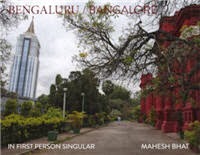 Title: Bangalore/Bengaluru: In first person singular Title: Bangalore/Bengaluru: In first person singular
Author: Mahesh
Bhat
Publisher:
Mahesh Bhat Publishing
Year: 2012
ISBN: 978-81-904535-1-6
This photo book delights the visual sense; at the same
time, the mind processes the subtle message of the image. And that is how the
author conveys the pain in his heart to his readers – not through cart-loads
of words on reams of acid-free paper, but through pictures (on art paper)
that reflect a city in all its living, and lively, detail.
The author begins with a brief acknowledgement of the
catalysts and supporters for this endeavor to narrate the story of Bangalore’s 25-year
journey of change. Contemporary thought leaders come first – Nandan Nilekani,
Subroto Bagchi. Nudging them (gently) are the artistes who, by the author’s
admission, ‘have been amazing’.
The book begins with a full-page photograph of a sunlit
field at the edge of a wood with a girl running across while her brother
stands by, playing his violin – a wide-open sky looks in interestedly. The
caption informs the reader that this field has now been imprisoned by a cigarette
factory at Chikkajala. The next
picture, three pages later, belongs to another world - urban squalor of
asbestos-capped shanties amidst piles of garbage dwarfed by futuristically
designed commercial complexes in the background. We have seen this picture – in cities that
grow breathlessly, and mindlessly.
The author asks “Whose city is it?”
Indeed, who has the right to stake first claim on Bangalore? Its cultural
denizens re-imagining concepts of life and living; IT professionals, taxi
drivers and businessmen from all parts of the country coming in search of a
new life; students; or its oldest residents holding fast to memories of the
first urban neighborhoods – whose is Bangalore?
A city is planned on sterile drawing boards to systematic
plans and proofs by conscientious engineers, farsighted patrons. Give the
city ample time, minimal space… and you will see it grow under the sun and
sky - amidst the confusion of livelihoods and living spaces, braving the
profusion of vehicles and vagaries of weather, through government inaction,
or worse, pot-bellied solutions to civic issues... the city will grow with a
life all its own, into a future that belies all predictions.
The harsh midday sun and the struggles it contains give the
city-face its character. The author documents Bangalore’s character evocatively. There
are so many pictures, and of such diversity – marketplaces, bus stands, and
women vegetable sellers glittering in diamond earstuds. Then there are dargahs, people celebrating
Durga Puja, as well as shops being set up for the day’s trade and the new
night life in the newly emerged part of the city.
Pages 56 and 57 present a contrast that truly mirrors
present-day Bangalore – the left page shows a line of four somber black
burqas adorning a shop window, deep undertones of demure womanhood. The right
page has a picture of a highlighted bright-red banner shouting, “Happiness
Sale Last 4 days left” and a line of four painted-up smiling ragdoll-faces
atop the banner. They both thrive – to each, Bangalore is home.
Pictures pack in power – elegantly. The portrait of the
descendants of Sir Mirza Ismail, five graceful matriarchs of varying vintage,
is a keepsake; old world charm that we lost in our relentless march into bold
new futures.
The chapter that leaves behind a lingering fragrance is
‘Bengaluru Karaga’. A ‘dramatic’ festival that began in the 1800s but still
has relevance for ‘struggles over urban space’, it encapsulates the essence
of the teeming city. It unifies across ‘geographical, religious, linguistic
and cultural’ divisions and is perhaps the only time when Hindu deities are
allowed to enter the precincts of a dargah, Tawakkal Mastan Dargah.
A city is the sum total of its citizens’ experiences. It is
what a rickshaw-puller feels when he sets down his first client at seven in
the morning; it is what the student sees as she takes the bus back home; it
is the child watching the birds in the school playground. The city shows a
different side to each of its citizens, like a million-sided prism. Each side
of the prism is true, and each side must keep pace with the other faces in
change and growth.
In frame after frame in this well-produced, sturdily-bound,
and smartly edited book, the reader sees the million-sided prism that is Bangalore, or Bengaluru…a
living, thriving organism suffused with energy and flaws, and radiant hope.
Author’s Bio: Mahesh Bhat is a Bangalore-based
photographer and has worked on projects for a number of publications in over
20 countries, all the way from New York
Times to Newsweek of Japan.
Reviewer’s Bio: Meenakshi Chawla is a Delhi-based writer
and writes book reviews for Contemporary Literary Review India.
|
||
Showing posts with label book review journal. Show all posts
Showing posts with label book review journal. Show all posts
Saturday, October 12, 2013
M Chawla Reviews Bengaluru / Bangalore: In First Person Singular
Meenakshi Chawla Reviews Bengaluru/ Bangalore:
In First Person Singular

Saturday, November 17, 2012
Savant Books Releases Tendai Mwanka's Novel "Keys in the River"
Savant Books Announces the Release of Tendai Mwanka's Novel "Keys in the River"


Keys in the River is a cycle of stories about economically-
The author, Tendai Rinos Mwanaka, was born in 1973, in
Nyanga, Nyatate, Mapfurira village, in the remote eastern highlands of Zimbabwe. He is
the author of "Voices from Exile," a collection of poetry on Zimbabwe's political situation and exile in South Africa
(Lapwing Publications, 2010). He has written numerous articles and won several
awards. "Logbook Written by a Drifter," and "Voices from
Exile" were both short-listed for the Erbecce Press Poetry Prize in 2011
and 2009, respectively. He was nominated for a Pushcart Award twice, once in
2008, and again in 2010, as well as commended for the Dalro Prize in 2008. He
has published over 200 short stories, essays, memoirs, poems and visual art
productions in over 100 magazines, journals, and anthologies in the following
countries: USA, UK, Canada,
South Africa, Zimbabwe, Cameroon,
Kenya, India, Italy,
France, Spain, Cyprus,
Australia and New Zealand. He
lives and stays in Chitungwiza,
Zimbabwe.
"In the spirit of self-promotion and with a wink and a
playful smile, I recommend to you 'Keys in the River'," says Mwanaka.
"Put on some good music, place some tasty food within reach, then let
yourself sink into the stories. Let the ideas growl within your consciousness.
Challenge all your perceptions about Africa and Zimbabwe until even your new
perspective becomes a howling, mangy dog. Now you know modern Africa.
I prescribe 'Keys in the River' is the best medication for people suffering
from this exhausting, frustrating and high-strung twenty-first-
Source: Originally published on a blog by Savant Books and Publications LLC.
|
Get
Your Book Reviewed by
Contemporary
Literary Review India
— journal that brings articulate writings for
articulate readers.
CLRI prides itself to have a good number of
review writers. We have different review writers for books of different
genres. Our reviews are gaining recognition among the publishers, journals
and academia for fair and high quality reviews. To know more about
book reviews, please visit: Book
Review Services
|
Saturday, October 13, 2012
Review on Vinay Capila’s The Revolution And Other Stories
"Vinay Capila is a compelling story teller. Vinay lets his stories evolve on their own and never makes the readers feel he is bending the storyline. That is the power of him."
– Khurshid Alam, Editor-in-Chief,
Contemporary Literary Review India
Meenakshi Chawla Reviews Vinay Capila’s The Revolution And Other Stories
Vinay Capila’s The
Revolution And Other Stories is for the winter afternoons when the sun is
old and mellow, and when the heart is seeking a warm refuge that envelopes,
gently. The stories display a ripeness of perspective that comes from accepting
the world—with all its flaws and flippancies. The readers can only conjecture
that they are – from the author’s life – a full and rich life.

The first story from which the anthology takes its title
‘The Revolution’ is a titillating read that takes the readers through
college-style ‘revolution’, that first flush of idealism and righteousness. The
lengthiest story in the collection, it stands its ground until the end – which,
incidentally, does not come as a surprise! The author builds up the
atmospherics in this one rather well woven story – the university comes alive
in one’s mind.
‘One Summer’ is a heart-warming story. It handles two
momentous events, first love and a loved one’s death, with the simplicity of
life itself. Nevertheless, there is innocence in the interactions between
Sunita and Vinod that touches the readers’ heart. Adolescents that they are
have not yet learnt the wiles of the world of adults. Where the story falters
is in dealing with the memory of that first love. First love is almost always
tender, and its memory almost always clutches at the heart in the most
unexpected ways, at the most unexpected times. But on second thoughts, the
author probably wishes to leave this understated.
‘Behind the Scenes’ is where the author is within his
comfort zone; a production has drawn to its close, the cast has silently
drifted away and the emptiness of endings enfolds the protagonist. Words and
sentiment are doled out with sharp sure jabs, as they would be in a stage
production. The author has captured the somber mood without arc lights and
cues.
‘Fish and Chips’ lays out the quirky paths wealth takes to
reach the people who have little or no need for it. Beneath the word-layers,
there also surges a question: what is real – that which the eye sees, or that
which the eye misses? So, indeed, which of the two Dr. Slopers is the real
deal? Which of them is the real inheritor of the millions of dollar left behind
by one of his relatives? The story flows naturally with the writer’s ink with
an innate honesty – no clever twists or showy turns.
The usage of Indianism (for example, ‘A year back’) makes
the language writer’s own, however sometimes it narrowly escapes slipping down
to less refined language. Also, some stories lack clear destination, such as
‘Shepherd on the Mountain’ where the narrative is lost in multiple threads –
the shepherd’s side, diary entries and a third perspective too.
The story unfolds largely in the protagonist’s mind and the
reader is led through a complex question-answer-wonderment plot. The essence of
a poetically-underpinned story is squandered in too much reflection and too
many questions.
‘The Battle Within’ might leave a reader puzzled in its wake
– does it or does it not deal with schizophrenia? The change in voice leads to
a disjuncture in understanding. The narrative tends to lumber in a
free-wheeling fashion.
Remarkably the writer, Vinay, escalates his sharp story
telling skill with ‘The Idealist’ – a nicely sketched story. Vinay sketches his
characters rather expertly: a line here, a flying curve there. It is left to
the readers to fill the details into a love story nuanced with life and living.
Here is a collection of stories a dreamer, or a ‘straggler’
in the material world, might pen in his diary – a gracious framing of
experiences, ideas and all those mundane days that made the man! The pieces
resemble lyrical sunsets – bringing to viewers, and readers, a vague feeling of
longing, a soft whispering sadness. The author, Vinay Capila, has been
successful in his objective in that the reader’s thoughts linger on a story
even after its last line has been read – just as the author’s mind might have
lingered after his pen had moved on. He makes the stories his own and they flow
on in their own rhythm – ebbing now and rising to a crescendo soon after. In
this, his telling is vaguely reminiscent of Guy de Maupassant’s early work. It
is a volume that every short story reader must add to his/her collection.
Reviewer: Meenakshi Chawla is a book review writer with Contemporary Literary Review India, and her writings have appeared with many other journals.
Reviewer: Meenakshi Chawla is a book review writer with Contemporary Literary Review India, and her writings have appeared with many other journals.
Book Title: The Revolution and Other Stories
Author: Vinay Capila
Category: Story Anthology
Publisher: Angus and Graphers Publishers Pvt. Ltd.
ISBN: 978-93-80254-05-0
Year Published: 2012
Pages: 293.
Author: Vinay Capila
Category: Story Anthology
Publisher: Angus and Graphers Publishers Pvt. Ltd.
ISBN: 978-93-80254-05-0
Year Published: 2012
Pages: 293.
|
Get
Your Book Reviewed by
Contemporary
Literary Review India
— journal that brings articulate writings for
articulate readers.
CLRI prides itself to have a good number of
review writers. We have different review writers for books of different
genres. Our reviews are gaining recognition among the publishers, journals
and academia for fair and high quality reviews. To know more about
book reviews, please visit: Book
Review Services
|
Subscribe to:
Posts (Atom)